 Plumber
 Bullhead City, AZ
Slab Leak Repair in Bullhead City, AZ
Leaks under concrete floors found precisely and fixed by spot repair, reroute or repipe — with the honest case for each.
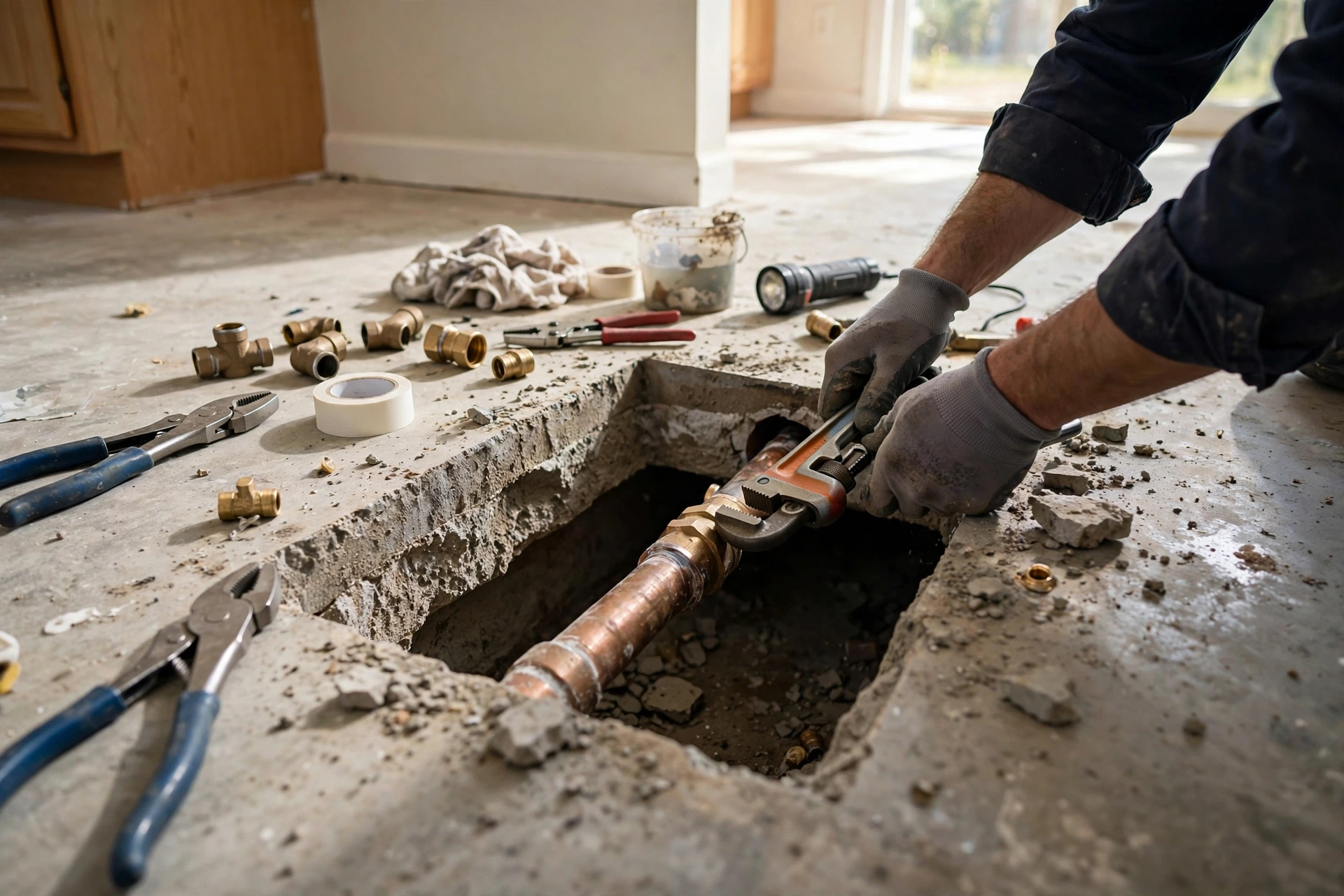
A slab leak is a water line leaking beneath the concrete floor of the home — and in Bullhead City, where a large share of houses from Sunridge Estates to Arroyo Vista sit on slabs, it is one of the defining plumbing repairs. The signs are subtle at first: a warm patch, a bill that creeps, a meter that never quite rests. Left alone, the leak washes fines from under the slab, feeds mould into wall bases and turns a repairable line into a flooring and foundation problem.
This page covers how slab leaks are confirmed, the three repair routes — direct spot repair through the concrete, rerouting the line overhead or through walls, and repiping the affected run — and how to choose between them without guesswork.
For pricing context before anything else, the Bullhead City cost page publishes the market ranges slab leak repair sits inside — starting with leak repair, simple above-slab (market range): About $94–$283 — slab access adds to this. And if your symptom is broader than slab leak repair, the Bullhead City plumbers homepage routes every common symptom to the right service.
What slab leak repair covers in Bullhead City
Supply lines routed under the slab were standard practice in the decades when much of Bullhead City was built. Copper under concrete lives a hard life here: mineral-heavy groundwater corrodes it from inside, hot lines expand and contract against abrasive concrete and aggregate, and slight ground movement works joints year after year. The leak itself is usually small — a pinhole, a split, a failed joint — but it runs twenty-four hours a day into soil that hides it.
Repair strategy therefore matters more than repair speed. Opening the slab at the pinpointed leak and fixing that spot is right for a young, otherwise sound line. For older copper showing general thinning, rerouting the run through the attic or walls ends the under-slab risk for that line permanently, at a cost often comparable to a second or third slab opening. The detection evidence — the pipe's age, material and condition at the opening — should drive the choice.
Warning signs you need this service
- A persistently warm or hot patch on tile or concrete flooring
- Water meter movement with all fixtures off
- A sudden or creeping rise in the water bill
- Cracks appearing in flooring or grout lines along one run
- The sound of water running beneath the floor in a quiet house
- Damp skirting, mould smell or warped baseboards on an interior wall
- A water heater that reheats far more often than it used to
- Low hot-water pressure compared with the cold side
What causes it here
Inside-out corrosion from mineral groundwater is the leading cause in Bullhead City, followed by abrasion where lines contact concrete or rub at slab penetrations, and joint failure under thermal cycling — hot lines in a desert home swing through wide temperature ranges daily. Electrolysis between dissimilar metals and high static pressure accelerate all three. Seasonal homes add a twist: lines that sit pressurised and stagnant for months corrode undisturbed, and the leak announces itself on the owner's return.
How the work is done
Every slab job starts with detection — meter confirmation, zone isolation, acoustic and thermal pinpointing — covered fully on our leak detection page. Then the routes diverge. Spot repair: a contained opening at the marked point, the failed section cut out and replaced, pressure test, patch. Reroute: the under-slab run is capped and abandoned, and a new line is run through walls or the attic with proper insulation against desert heat. Repipe: where multiple runs are failing, the affected system is replaced wholesale. Each ends with a full pressure test so the repair is verified across the whole zone, not just at the opening.
In depth — what experience teaches about this job here
The spot-repair-versus-reroute decision deserves its numbers, because it recurs across this city. A spot repair costs one opening, one patch and one section of pipe. A reroute costs a longer run of new pipe through walls or attic, but it permanently retires the under-slab run. The break-even question is how many more openings the old copper has in it — and the pipe exposed at the first opening answers it: wall thickness, pitting depth and the green-black corrosion pattern are readable evidence. A household shown that evidence rarely chooses wrong; a household sold a route without seeing the pipe is guessing with the plumber's confidence.
Flooring is the hidden variable. A spot repair under carpet or luxury vinyl is a modest patch; the same repair under continuous large-format tile can mean sourcing matching tile that may no longer exist. Reroutes avoid the floor entirely, which is why tile-heavy remodels in Desert Foothills and Sunridge so often choose them even when the pipe alone might have justified a spot fix. Ask for both figures with flooring honestly included — the comparison is only real when the patch is priced, not just the pipe.
How your housing type changes the job
Slab-built homes. This is the slab home's defining repair, and the spot-versus-reroute evidence — the exposed pipe's own condition — is discussed with the owner before the route is chosen.
Manufactured homes. Manufactured homes do not have slab leaks, but they have the belly equivalent: a line leaking into insulation under the floor, detected and repaired by the same pinpoint-first logic.
Seasonal homes. Seasonal slab homes are checked on return as a matter of routine, because a slab leak in an empty house has had the whole summer to bill and to undermine.
- Confirm the suspicion with a two-hour meter test before calling — it sharpens the visit
- Note whether the warm patch follows the hot side by checking if it cools when the heater is off
- Clear the room above the suspect area so detection equipment can work the floor
- Do not jackhammer exploratory holes — pinpointing first routinely saves the floor
- Photograph flooring before any opening so patch matching is documented
The visit, step by step
Call with the symptoms and your floor type — tile, laminate or carpet over slab
Detection pinpoints the leak and the line's material and age are assessed
Spot repair versus reroute is decided on the evidence, with costs for both
The chosen repair is completed, pressure-tested across the zone
Concrete or flooring is patched to a finish-ready standard and the meter re-checked
What it costs — market ranges
| Item | Range / basis |
|---|---|
| Leak repair, simple above-slab (market range) | About $94–$283 — slab access adds to this |
| Slab spot repair | Quoted after pinpointing; depth and flooring drive the figure |
| Line reroute (per run) | Quoted per length and route; often rivals repeat spot repairs over time |
| Burst or major line repair ceiling (market range) | Complex repairs can approach $2,836 |
Ranges above draw on the published Bullhead City market data collected on our cost page. Your figure is set after the job is seen, and explained against those ranges.
A slab leak is urgent rather than frantic: the damage accrues daily, so book detection promptly, but a stable suspected slab leak does not need a midnight call. Water actively surfacing through flooring, or a fast-spinning meter, upgrades it to same-day.
Slab Leak Repair FAQs
How much does slab leak repair cost in Bullhead City?
There is no responsible flat price: a shallow spot repair under carpet differs enormously from a deep line under tile that should really be rerouted. Published market ranges put simple leak repairs around $94–$283 before slab access, and complex pipe repairs can approach $2,836. After pinpointing, you will get figures for the spot repair and the reroute side by side so the choice is yours with real numbers.
Should I repair the spot or reroute the line?
Repair the spot when the pipe is young and the failure is a single joint or a localised abrasion. Reroute when the copper is old, pinholing, or has leaked before — each new opening costs money and flooring, and a rerouted line removes that run from the slab permanently. The condition of the pipe exposed at the first opening is the best evidence, and you will see it.
Will a slab leak damage my foundation?
It can. A long-running leak washes supporting fines from beneath the slab and keeps the sub-base wet, which can contribute to settlement, flooring failure and mould in adjacent walls. Most slab leaks caught at the warm-patch or bill-creep stage are repaired long before structural harm — which is exactly why prompt detection matters more than repair heroics.
How long does a slab leak repair take?
Detection and a spot repair can often be completed in a day once the leak is pinpointed. A reroute typically runs one to two days depending on length and route. Flooring restoration beyond a patch — matching tile or relaying laminate — is scheduled after the pressure test proves the line is sound.
Why did my slab leak appear right after we returned for the season?
Seasonal Bullhead City homes sit pressurised for months; corrosion works undisturbed, and a line that was weeping in June may open fully by October. The first heavy use on return — heaters reheating, every fixture cycling — is when the weakened point gives way. A return-home leak check is cheap insurance for snowbird households.
Does homeowners insurance cover slab leaks?
Policies commonly cover the resulting water damage but not the pipe repair itself, and access costs vary by policy. That is between you and your insurer — what a plumber can do is document the leak's location, cause and the damage pattern with photos and a written summary, which most owners find their claim needs.
Living with the decision: spot repair, reroute, or repipe
Once a slab leak is located, Bullhead City homeowners face a three-way decision that deserves more than a doorstep verdict. A spot repair opens the floor at the pinpointed spot and fixes the failed section — the least disruptive choice when the surrounding pipe tests sound and the leak is a single event. A reroute abandons the buried run and carries the line through walls or attic space instead, which suits homes whose under-slab pipe is generally ageing: it costs more than one opening today and far less than a second and third opening over the coming years. A fuller repipe enters the conversation when leaks have already repeated. None of these is the universally correct answer; the honest recommendation depends on the pipe's overall condition, and that condition can be assessed — from the exposed section, the home's age and its leak history — rather than guessed.
Flooring, dust and the practical side of opening a slab
Homeowners dread the mess as much as the bill, so the practicalities deserve plain words. A careful spot opening is a localised job: the work area is isolated, the concrete is cut rather than smashed where possible, and the excavation is only as wide as the repair requires. Tile and laminate floors complicate the finish rather than the plumbing — matching discontinued tile is the common frustration, which is why saving spare tiles from any installation pays off years later. Ask before work starts how the opening will be protected overnight, how spoil and dust are handled, and what state the floor is left in, so the restoration conversation happens while choices still exist.
Why slabs leak here, specifically
Bullhead City stacks several causes at once. The mineral groundwater corrodes copper from inside over decades, thinning walls until a pinhole opens. Desert soils shift subtly with moisture and temperature cycles, stressing rigid buried lines. Original construction sometimes left lines in contact with abrasive fill, so vibration and thermal expansion wear the pipe from outside. Recognising which cause is at work in your home matters because it predicts the future: corrosion distributed along a run argues for rerouting, while a single abrasion point on otherwise healthy pipe makes a spot repair a rational, durable fix rather than a gamble.
- Treat a warm patch of floor as evidence; note its location and whether it spreads over days.
- Ask whether the exposed pipe's condition was inspected beyond the leak itself before choosing spot repair.
- Keep any spare flooring from installations; a handful of saved tiles can save an entire room's finish later.
- If this is a second slab leak, price the reroute seriously — repetition is the pipe giving its overall verdict.
- Confirm how the finished opening is re-compacted and patched so flooring laid over it does not settle or crack.
Market framing for the surrounding work sits on the Bullhead City cost page — straightforward leak repairs run roughly $94–$283 before slab access enters the figure — and a call to (928) 693-1910 starts with locating your leak precisely, because every sensible option is priced from that point.
Insurance, documentation and the paper side of a slab leak
Slab leaks often involve a second audience besides the plumber: an insurer. Coverage varies widely — many policies distinguish between the cost of accessing the leak and the cost of repairing the pipe itself — but every version of the conversation goes better with documentation. Photograph the detection marks before any cutting, keep the pinpointing notes with distances and method, save the removed pipe section, and record dates from first suspicion to repair. That file also serves a purely practical purpose years later: it tells the next plumber, or the next owner, exactly where the slab was opened, what was found and which option was chosen, turning one home's expensive lesson into permanent, transferable knowledge about its buried lines.
Related services and areas
Homeowners dealing with this often also need emergency plumber · drain cleaning · hydro jetting · leak detection · water heater repair — and local help from a plumber in Bullhead City who knows the housing on your street. Neighbourhood pages: Riviera · Riverview Park · Laughlin Ranch · Fox Creek · Sunridge Estates · Buena Vista · Holiday Shores · Holiday Highlands · Desert Foothills Estates · Arroyo Vista · Bullhead City Center · Playa del Rio · Rio Lomas · Hancock Road Corridor. Town pages cover Fort Mohave, Mohave Valley and Laughlin, NV.
Talk to a Bullhead City plumber today
One call, a real conversation about your job, and an honest next step.
(928) 693-1910Call (928) 693-1910